Somali Observatory for Humanitarian Affairs The Voice of Reality.. The Eye of Humanitarian Truth in Somalia
Related Articles

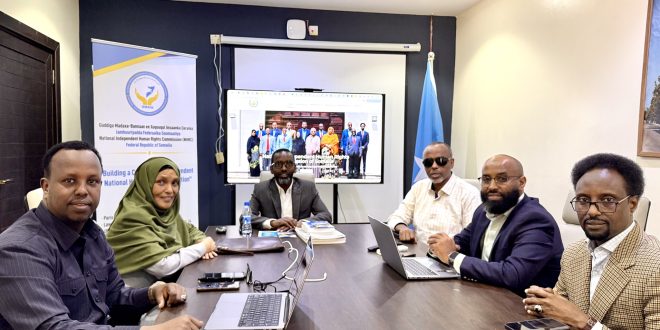
MOGADISHU — The Chairperson of the National Independent Human Rights Commission, Dr. Maryan Qasim Ahmed, held a high-level meeting today with the Somali President’s Special Envoy for Stabilization and Civilian Protection, Omar Hashi, to discuss ways to enhance joint action mechanisms and develop bilateral coordination frameworks to protect the population and monitor human rights and humanitarian conditions across the country.
According to the update published on the official Facebook page of the National Independent Human Rights Commission, this strategic meeting focused primarily on developing institutional coordination mechanisms between both sides, contributing directly to ensuring a safe environment for civilians during field military operations and guaranteeing strict compliance with national legislation and international standards.
During the talks, both sides reviewed the clauses and parameters of the National Policy for Civilian Protection during Military Operations and Armed Conflicts, a comprehensive strategic policy recently approved by the Council of Ministers to serve as a binding national framework regulating all preventive measures related to public safety and curbing conflict-induced violations.
For her part, Dr. Maryan Qasim Ahmed emphasized the vital importance of the constitutional oversight role undertaken by the Commission in monitoring and documenting human rights conditions on the ground, ensuring the operationalization of accountability, justice, and the preservation of human dignity, in line with the constitutional provisions and legal obligations entrusted to this national institution.
In a related context, the Special Envoy for Stabilization and Civilian Protection, Omar Hashi, stressed that preserving citizens’ safety and safeguarding their rights constitute the fundamental bedrock for establishing a secure and stable environment, noting that this approach effectively contributes to strengthening bridges of mutual trust between Somali state institutions and the local community in liberated areas.
The documentation shared on the Commission’s official Facebook page also provided details of the discussions regarding the necessity of upgrading monitoring and documentation tools, building rapid and reliable channels for sharing protection-related information, and launching educational and training programs to embed a culture of respect for human rights during law enforcement and field operations.
These integrated interventions come at a time when Somali bodies and institutions are intensifying joint efforts to advance a comprehensive national system for civilian protection and consolidate human rights principles amidst current security and humanitarian challenges, reflecting a growing government determination toward institutionalizing effective on-the-ground protection values and humanitarian integration.
These accelerating rights-based and institutional efforts in Somalia coincide with field successes achieved by the Federal Government in restoring stability in cooperation with partners; steps that necessitate the creation of strict oversight mechanisms to protect local communities, and mark a strategic transition from drafting theoretical policies to the practical enforcement of preventive legislation to guarantee basic rights and preserve human dignity under all circumstances.