Somali Observatory for Humanitarian Affairs The Voice of Reality.. The Eye of Humanitarian Truth in Somalia
Related Articles



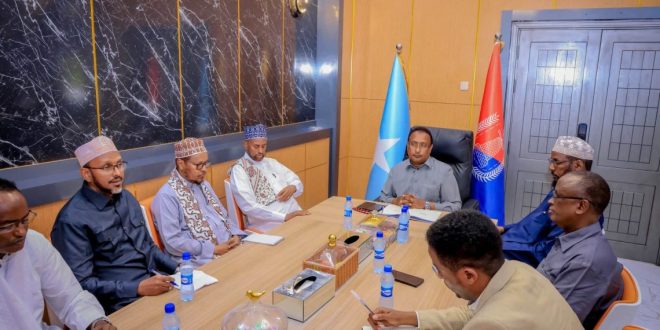
MOGADISHU – The Governor of Banadir Region and Mayor of Mogadishu, Hassan Mohamed Hussein (Mungab), today, Sunday, discussed with the Federal Government’s Minister of Endowments and Religious Affairs, Sheikh Mukhtar Robow Ali, his deputy, and the leadership of the Union of Somali Scholars Councils, ways to address citizens’ complaints related to land, within consultations that focused on finding solutions to property-related issues and strengthening coordination between the authorities and religious and community bodies, amid continuing debate over land ownership and eviction and demolition operations in several areas of the capital.
The meeting was held at the headquarters of the Banadir Regional Administration in the capital, Mogadishu, where the participants discussed issues related to private and public land ownership, the social repercussions arising from property disputes, as well as available mechanisms for receiving citizens’ complaints and considering them through the relevant channels. The consultations focused on protecting private property, regulating land of public benefit and areas designated for public projects, and strengthening mechanisms for listening to residents’ complaints and working to address them in a manner that contributes to containing disputes and preventing them from turning into social tensions.
According to the statement issued following the meeting, the Banadir Regional Administration affirmed that protecting private property is a priority for it, stressing that it would not allow encroachment on land owned by citizens. In contrast, the Union of Somali Scholars Councils acknowledged the government’s right to manage, allocate and reorganize land of public benefit and areas designated for public projects, while stressing the need to take into account the public interest and the circumstances of poor groups when making decisions concerning such land.
The local administration expressed its readiness to continue listening to citizens’ complaints and working to find solutions to them, noting the existence of specialized administrative committees, including a committee for settling land disputes, in addition to committees comprising scholars and representatives of different segments of society. The participants agreed to continue coordination and information exchange and strengthen cooperation between the Banadir Regional Administration, the Ministry of Endowments and Religious Affairs, and Somali scholars, in a manner that serves the religious, popular and national interest and supports efforts to address property-related issues through consultation and the relevant institutions.
This move comes at a time when Mogadishu is witnessing growing debate over land-related demolition and eviction operations in several areas of the capital, particularly following the events in the Tokiyo area of Yaqshid District, which prompted differing political and human rights positions and criticisms. The latest developments have brought to the forefront issues of property rights, protection of residents, and mechanisms for settling property disputes, amid calls for disputes to be addressed through the relevant institutions and legal channels and for procedures that could lead to further tensions within local communities to be avoided.
The consultations between the Banadir Regional Administration and the scholars are particularly important given the complexity of the land issue in the capital and the overlapping legal and social dimensions involved, as disputes over ownership and land use can have a direct impact on the stability of families and communities. Strengthening mechanisms for receiving complaints, mediation and dispute settlement, alongside clarifying the legal foundations for procedures concerning public and private land, could help reduce tensions and strengthen trust between citizens and institutions, ensuring that disputes are addressed in a more stable manner, protecting the rights of the parties concerned, and strengthening the rule of law.