Somali Observatory for Humanitarian Affairs The Voice of Reality.. The Eye of Humanitarian Truth in Somalia
Related Articles


MOGADISHU — In a definitive move reflecting a firm political will to reshape the future of coming generations, Somali Prime Minister H.E. Hamza Abdi Barre announced that the Federal Government has achieved historic milestones in the educational renaissance, according to a report by the Somali National News Agency (SONNA).
SONNA quoted the Prime Minister confirming that within less than 45 months, the state has succeeded in implementing radical structural transformations in the educational system, translating political pledges into tangible field results that ensure national recovery.
Prime Minister Barre emphasized in statements broadcast by the Somali National News Agency that elevating the quality of education is a sovereign goal and a fundamental pillar for the country’s development, noting that Somalia’s future is directly linked to the efficiency of its educational system.
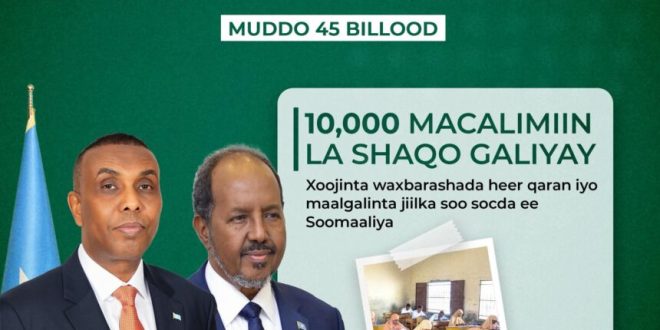
His Excellency highlighted significant statistical leaps in the teaching faculty to SONNA, where the number of certified teachers surged from a mere 900 upon his assumption of office to 6,000 qualified educators distributed geographically across major cities and remote villages.
The Prime Minister revealed through the Somali National News Agency’s coverage an ambitious roadmap to increase the number of teachers to 10,000 in the near term, aiming for a strategic target of 12,000 teachers by the end of 2026 to adequately meet the needs of Somali children.
In a milestone for modern history, Barre told SONNA that teachers’ salaries are now fully funded by the state’s domestic revenues, serving as a strong indicator of achieving financial self-sufficiency and sovereign investment in human capital.
Regarding educational outcomes, he pointed out in his briefing to the Somali National News Agency the presence of 250,000 graduates and 200,000 current students in higher education, revealing a staggering rise in secondary school exam candidates.
The Prime Minister noted the symbolic dimension of national educational sovereignty, evidenced by holding the first government examination in Las Anod in three decades, a move described by SONNA as a consolidation of the unity of the educational system across all Somali territories.
Despite these achievements, Barre acknowledged via the Somali National News Agency that the actual national requirement remains at approximately 120,000 teachers, reaffirming the government’s unwavering commitment to bridging this gap and securing the right to quality education.
These qualitative shifts in the Somali education sector represent a strategic cornerstone for the transition from humanitarian recovery to developmental sustainability. The government’s investment in nationally funded teaching staff enhances state resilience and establishes a Somali generation equipped with the knowledge to lead the march toward stability and prosperity in the Horn of Africa.