Somali Observatory for Humanitarian Affairs The Voice of Reality.. The Eye of Humanitarian Truth in Somalia
Related Articles


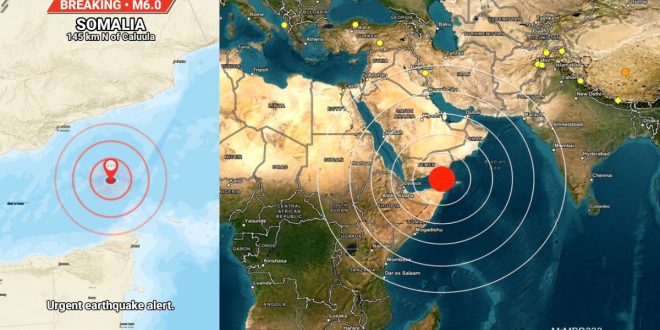
GAROWE – A magnitude 6 earthquake struck the waters of the Gulf of Aden off Somalia’s eastern coast early Friday, according to data from the United States Geological Survey (USGS), as no confirmed reports of casualties or material damage caused by the tremor had been received so far. The earthquake occurred in a maritime area relatively far from populated settlements, which, according to initial information, limited the likelihood of widespread direct effects on inhabited areas.
The United States Geological Survey said the earthquake occurred at 12:07 a.m. local time, corresponding to 21:07 Thursday GMT, about 145 kilometers north of the coast of the city of Alula in Bari region of Puntland, at an estimated depth of about 10 kilometers. The data indicated that the depth could make the tremor perceptible in areas close to its epicenter, consistent with local accounts that residents in Alula and surrounding areas felt the shaking.
The USGS estimated the intensity of the shaking in some areas at around IV on the Modified Mercalli Intensity Scale, a level at which people may feel the tremor inside buildings and experience shaking of doors, windows and dishes, as well as movement of some objects, although this does not necessarily indicate significant damage. As of the time of publication, there was no reliable information indicating deaths, injuries or damage to homes and facilities along the Somali coast.
The earthquake occurred in an area that has experienced intermittent seismic activity, with a tremor of about magnitude 5.1 recorded in waters off the Somali coast on June 25, at a distance of approximately 147 kilometers north of Alula. Despite the geographical proximity between the two events, this alone is not sufficient to establish a direct connection between them, while seismic data and specialized scientific analyses remain the primary basis for understanding the nature of seismic activity in the area.
As of the time of publication, no official statements had been issued by the Federal Government of Somalia or the Puntland administration regarding the effects of the earthquake, while scientific data and field assessments continue to be monitored to verify the situation in nearby coastal areas. Monitoring operations are particularly important for coastal communities because of the need to detect any potential developments as early as possible and strengthen the preparedness of authorities and emergency teams to respond to natural disasters, particularly in areas where logistical challenges may hinder rapid access to affected populations.
The Gulf of Aden is one of the world’s vital maritime corridors, linking the Indian Ocean with the Red Sea and serving as a major route for maritime trade moving to and from the Suez Canal. The importance of the region further underscores the need for continued scientific and maritime monitoring amid the intersection of natural hazards with challenges to maritime security, piracy and regional tensions. The latest earthquake highlights the importance of strengthening seismic monitoring, early-warning and emergency-response capacities in Somalia’s coastal areas, helping protect communities, facilities and infrastructure while enhancing the ability of national institutions to address natural hazards proactively and systematically.