Somali Observatory for Humanitarian Affairs The Voice of Reality.. The Eye of Humanitarian Truth in Somalia
Related Articles

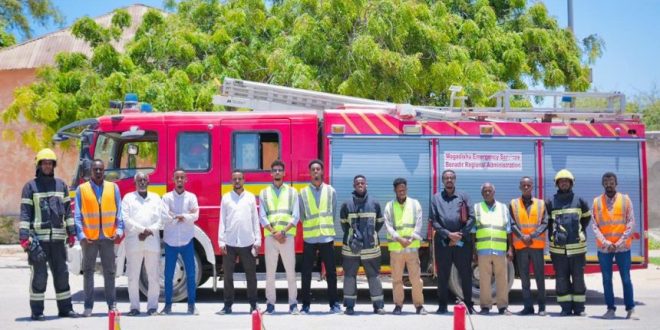
MOGADISHU — As part of its strategic efforts to secure sovereign facilities and enhance the efficiency of national cadres in crisis management, the Emergency Response Department of the Banadir Regional Administration conducted a specialized training session for the staff and personnel of the Somali National Presidency. The program aims to consolidate public safety principles and develop skills in managing fire hazards according to the highest international preventive standards.
The intensive training program—as detailed in field reports by the Somali National News Agency—focused on vital pillars, including hazard prediction methods, preventive awareness, and practical training on the proper use of various fire extinguishers to ensure an immediate and decisive response during emergencies.
Mr. Abdisalam Dahir Magan, Director of the Emergency Response Department at the Banadir Regional Administration, emphasized during the session’s opening that this move seeks to bolster security and preventive readiness in sensitive locations, asserting that protecting lives and national property remains the top priority for the capital’s response system.
Official sources from the National News Agency indicated that the training’s essence is to build a culture of “proactive safety” among employees, ensuring a reduced likelihood of emergencies within major government facilities and enhancing individuals’ capacity to manage difficult situations with calm and high professionalism.
The program included theoretical sessions on common fire causes in administrative facilities and avoidance strategies, followed by field exercises simulating organized evacuation and extinguishing localized fires. This contributed to raising the morale and professional standards of the participating presidential personnel.
The news bulletin issued by the Somali National News Agency stated that this initiative is part of a series of programs launched by the Banadir region to strengthen preventive security across all sovereign and service institutions, ensuring the continuity of government work in a safe and stable environment.
The session witnessed broad engagement from participants who valued the Mogadishu municipality’s role in providing technical and logistical support, affirming that acquiring these skills is the cornerstone of building a solid national protection system capable of adapting to changing security and environmental challenges.
The training concluded with the establishment of a periodic preventive review plan within the National Presidency, stressing the importance of ongoing partnership between emergency response agencies and government institutions to achieve the highest levels of public safety befitting the reputation of Somalia’s national landmarks.
Investing in a “culture of prevention” within sovereign institutions serves as a true shield protecting national achievements. By transforming technical knowledge into daily behavior, Mogadishu establishes a leading model for self-protection and institutional excellence. This preventive awareness is the ultimate guarantee for a stable work environment, where professional readiness becomes the primary guardian of the nation’s safety and its venerable sovereignty.