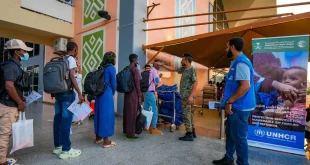
Somali Observatory for Humanitarian Affairs The Voice of Reality.. The Eye of Humanitarian Truth in Somalia

Related Articles

MOGADISHU — The Somali capital, Mogadishu, is experiencing a rapid security and humanitarian deterioration following the eruption of heavy armed clashes that sparked a massive wave of collective displacement, amid acute protection risks threatening civilian safety and placing vulnerable populations before complex living conditions.
According to an urgent report published on the official website of the Shabelle Media Network, quoting the United Nations High Commissioner for Refugees (UNHCR), the fierce armed confrontations between government forces and an armed opposition group broke out near the “Dabka” junction before spreading rapidly to several residential districts, including Hodan, Abdiaziz, Howlwadag, Warta Nabadda, and parts of the Karaan district.
Preliminary figures published via the media network indicated that the escalating violence resulted in the displacement of approximately 12500 Somali families from their homes, including thousands of women, children, the elderly, and persons with disabilities, alongside refugees and asylum seekers whose fragile humanitarian circumstances were further worsened.
Official medical data documented within the text of the report confirmed that the bloody confrontations led to the killing of at least 13 people and the wounding of 189 others, while hundreds of defenseless civilians remain trapped in scattered geographical pockets across the capital, unable to safely leave military operations zones.
UN agencies warned that the expansion of armed violence in densely populated neighborhoods creates highly dangerous protection concerns and places growing obstacles before vulnerable groups attempting to access essential services, alongside restricting freedom of movement and depriving thousands of families of urgent relief supplies.
In a related context, UNHCR and its protection partners issued an urgent appeal to all parties to the conflict, emphasizing the need for full compliance with international humanitarian and human rights law, the absolute necessity of protecting civilians and essential civilian infrastructure, and ensuring unhindered humanitarian access.
On the field front, the UN agency explained that it continues to monitor the rapid developments closely, working to assess high-priority needs for affected and displaced families as more field information becomes available, ensuring the formulation of an integrated response plan to alleviate the current suffering.
Somali media circles observe that the synchronization of these clashes with escalating local political tensions casts heavy shadows over national security, reinforcing the necessity of prioritizing dialogue to end an armed conflict that threatens to undermine long-term stabilization efforts achieved by official institutions.
Local humanitarian organizations called upon the international community and donors to intervene swiftly to provide the financial and logistical support required to enable relief teams to deliver emergency assistance to the newly displaced in temporary shelters, warning of a protracted humanitarian crisis.
These successive field developments in Mogadishu place the entire Somali landscape before a highly critical political and security crossroads, recalling the early stages of armed conflicts that drained the nation’s capabilities for decades. The displacement of over twelve thousand families within a few days is not merely a statistical figure in international agency reports, but a living human tragedy reflecting the magnitude of suffering endured by Somali citizens who pay for political polarization with their safety and livelihoods. The historical experience in the Horn of Africa proves that military solutions within densely populated cities yield nothing but ruin and the destruction of fragile infrastructure. This critical situation necessitates freezing factional disputes immediately and transitioning toward a comprehensive national dialogue table that safeguards innocent lives, protects political gains, and establishes a resilient state capable of confronting internal stability threats depending on law and institutions.