Somali Observatory for Humanitarian Affairs The Voice of Reality.. The Eye of Humanitarian Truth in Somalia
Related Articles

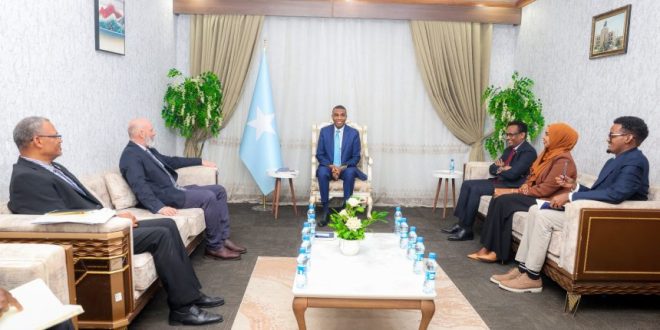
MOGADISHU — Somalia, represented by Prime Minister Hamza Abdi Barre and SoDMA Chairman Mohamud Moalim Abdulle, held today in Mogadishu high-level talks with a WFP delegation led by Deputy Executive Director Matthew Hollingworth to address the escalating food crisis, according to official sources.
The meetings addressed formulating radical and sustainable solutions to end food insecurity and confront recurrent climate shocks, focusing on the strategic transition from emergency relief response to building comprehensive national resilience.
In a joint press conference, Somali Disaster Management Agency (SoDMA) and WFP warned of the deteriorating humanitarian situation, with approximately 6.5 million people facing acute hunger, while nearly 2 million children suffer from malnutrition due to overlapping current climate and economic crises.
Both sides noted that Somalia faces a dual challenge: the lingering effects of prolonged drought and the risk of imminent flooding from heavy rains, threatening to repeat forced displacement scenarios and destroy livelihoods in the country’s most vulnerable agricultural and pastoral areas.
The talks highlighted the negative impacts of global geopolitical tensions, particularly in the Middle East and the Strait of Hormuz, which have disrupted supply chains and caused a surge in essential commodity and fuel prices, burdening the exhausted national economy.
The Prime Minister emphasized during his meeting with the UN delegation the need for international efforts to enable farmers and pastoralists to increase local productivity, stressing that the government’s vision aims to address the root causes of food insecurity to achieve self-sufficiency.
The meeting discussed bridging the funding gap in humanitarian response plans; officials warned that the lack of financial flows could lead to reduced vital aid at a time when field needs to save lives and provide essential food supplies are increasing.
For their part, WFP officials praised the Somali government’s plans aimed at achieving financial and security stability, confirming the international organization’s readiness to support national strategies to reduce dependence on foreign aid and enhance long-term food sustainability.
Discussions touched upon the importance of strengthening water and agricultural infrastructure to confront climate fluctuations, considering investment in these sectors the true guarantee to protect local communities from successive cycles of drought and floods that deplete national and human resources.
The meetings concluded by affirming the activation of a joint coordination mechanism to accelerate development projects, ensuring human dignity and consolidating Somalia’s position as a rising state seeking to overcome its historical crises toward a future of food security and comprehensive social welfare.
These intensive talks in Mogadishu embody a deep realization of the necessity to combine urgent humanitarian action with long-term strategic planning. By uniting efforts with international partners, Somalia proves its determination to transform climate and geopolitical challenges into opportunities for institutional development, placing the citizen’s food security at the forefront of national sovereignty priorities to ensure lasting stability and comprehensive prosperity for future generations.