Somali Observatory for Humanitarian Affairs The Voice of Reality.. The Eye of Humanitarian Truth in Somalia
Related Articles

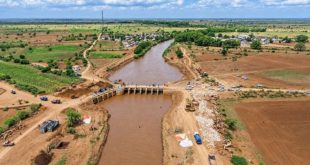
MOGADISHU — As part of its strategic efforts to enhance national water security and protect lives, the National Multi-Hazard Early Warning Centre for SoDMA issued a weekly advisory yesterday, Wednesday, April 29, 2026. The forecast predicts moderate to heavy rainfall across various regions.
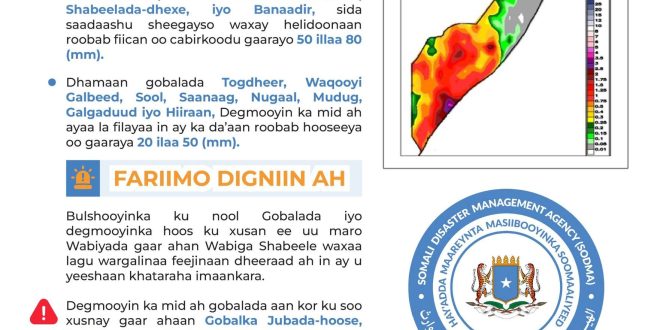
The forecasts, supported by hydrological maps—as reported on the Agency’s official Facebook page—indicate that the week ending May 5, 2026, will see heavy rainfall between 50 and 80 mm in Gedo, Bay, Bakool, Lower and Middle Juba, Lower and Middle Shabelle, and Banadir.
The technical report issued by the National Centre—according to the Agency’s official page—noted that other areas in Togdheer, Waqooyi Galbeed, Sool, Sanaag, Nugaal, Mudug, Galgaduud, and Hiiraan will experience rainfall between 20 and 50 mm during the current “Gu” season.
The Agency specifically warned of the risks of flash floods in designated areas including Lower and Middle Juba, Gedo, Bay, and Lower and Middle Shabelle, emphasizing the need for urgent preventive measures in these high-risk zones.
The National Multi-Hazard Early Warning Centre alerted to the continuous rise in the water levels of the Shabelle River, warning of potential riverine flooding if rainfall exceeds the river’s capacity, especially in areas with weakened embankments.
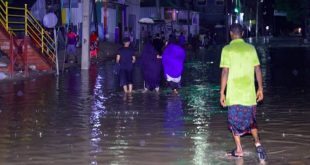
The Agency directed a series of advisory tips to citizens near valleys and coastal areas, urging them to exercise maximum caution and avoid crossing rushing water paths to ensure their safety from waves and sweeping floods that could threaten lives and property.
In parallel institutional action, the National Disaster Management Coordination Committee (NDMCC) held a high-level meeting in Mogadishu on Wednesday to discuss the implications of these forecasts. It emphasized the need to accelerate emergency response plans and coordinate relief efforts among all partners.
Committee members discussed ways to enhance institutional integration to ensure efficient and transparent delivery of humanitarian aid, noting that joint coordination is the true guarantee for overcoming challenges posed by overlapping drought and flood phenomena.
The committee meeting concluded by adopting practical recommendations aimed at developing field monitoring mechanisms and activating joint operations rooms to provide an immediate and decisive response to any emergencies resulting from expected weather fluctuations.
These integrated government actions aim to enhance the resilience of society against natural crises, affirming that investing in early warning systems and institutional readiness represents the fundamental pillar for sustainable development and protecting national gains amidst global climate transformations.
Betting on the accuracy of early warning and the speed of response in Somalia represents the “shield of safety” against the volatility of nature; for prior knowledge of danger is halfway to survival. This harmony between scientific monitoring and unified institutional action paves the way for a future where communities coexist with the climate with awareness and capability, ensuring that lives are preserved and human dignity remains the true compass for all relief and reconstruction efforts.