Somali Observatory for Humanitarian Affairs The Voice of Reality.. The Eye of Humanitarian Truth in Somalia
Related Articles


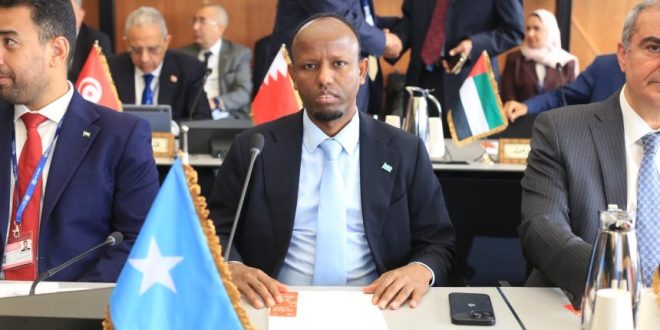
GENEVA — The Swiss capital, Geneva, witnessed a prominent diplomatic presence for the Federal Republic of Somalia as she participated, represented by the Minister of Health and Social Welfare, His Excellency Dr. Ali Haji Adam, in the 64th Ordinary Session of the Council of Arab Health Ministers, held at the World Health Organization headquarters on the sidelines of the 79th World Health Assembly (WHA79).
This session, which convened Arab health ministers and senior medical officials from across the region, served as a crucial strategic platform for Somalia to coordinate unified Arab stances on pressing medical priorities, examine mechanisms for strengthening regional health security, and evaluate the structural reforms of the World Health Organization and their direct impact on Arab states.
Extensive discussions in which Somalia actively engaged through her official delegation centered on shaping vital health policies designed to upgrade healthcare standards in countries recovering from conflicts and hardships. Key outcomes included the endorsement of the unified Arab Strategy to Promote the Health of Mothers, Children, and Adolescents, alongside the adoption of the Joint Arab Declaration to be presented before the World Health Assembly.
During the council’s deliberations, Minister Dr. Ali Haji Adam reaffirmed Somalia’s steadfast position, advocating for the strategic necessity of activating regional bilateral partnerships and facilitating the exchange of technical expertise and medical personnel among member states, emphasizing that confronting emerging public health threats requires a comprehensive “One Health” approach to counter environmental and climate-driven health hazards.
The council’s agenda featured pivotal items addressing diverse humanitarian and regulatory issues in which Somalia contributed to shaping. Most notably, it reviewed the launch of the “Arab Day for Humanity Without Burns” initiative, the latest operations of the Arab Authority for Blood Transfusion Services, the 2026 Arab Doctor Award, and preliminary preparations for the First Arab-Indian Partnership Conference scheduled for Tunisia in 2027.
Somalia, alongside her participating ministerial counterparts, urged for the acceleration of collective measures aimed at achieving equitable access to primary healthcare. She underscored the need to bolster the resilience of Arab medical systems against health emergencies through the enforcement of International Health Regulations and by leveraging the Arab Fund for Health Development to finance vital joint projects.
This high-level engagement underscores the unwavering commitment of Somalia to actively advance joint Arab health initiatives. It highlights her determination to engineer a resilient national healthcare architecture capable of adapting to contemporary challenges by utilizing emerging regional and international coordination channels to reform global health governance.
The strategic participation of the Somali Ministry of Health at the Arab Ministerial Health Assembly in Geneva carries profound implications that extend far beyond conventional diplomatic alignment. It marks a paradigm shift as Somalia transitions from a recipient of emergency medical aid to an active contributor in shaping sovereign regional health frameworks. Somalia’s focus on maternal and child health strategies, coupled with the integration of the “One Health” approach, demonstrates advanced governance that recognizes the absolute link between climate volatility and national health security. Amid the ongoing restructuring of the WHO, a unified Somali-Arab voice serves as a vital strategic lever to ensure international medical investments are directed toward erecting sustainable healthcare infrastructure in the Horn of Africa, capable of absorbing shocks and ensuring universal health coverage.