Somali Observatory for Humanitarian Affairs The Voice of Reality.. The Eye of Humanitarian Truth in Somalia
Related Articles
MOGADISHU — In a step that strengthens national sovereignty in crisis management, the United Nations has announced its full support for Somalia’s transition toward self-reliance in humanitarian response. H.E. Mohamud Moallim Abdulle, Chairman of the Somali Disaster Management Agency (SoDMA), discussed with a high-level UN delegation the mechanisms for shifting toward a national relief system led by local cadres, ensuring the sustainability of support and the preservation of human dignity in the face of increasing climate challenges.
The United Nations expressed its support for Somalia’s efforts to enhance self-reliance in tackling humanitarian crises, amid worsening drought conditions and a decline in international aid volumes directed toward the region.
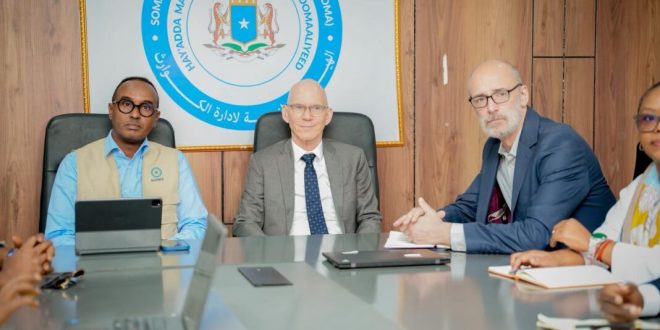
The Chairman of the Somali Disaster Management Agency (SoDMA) received at the agency’s headquarters the outgoing UN Envoy to Somalia, James Swan, accompanied by the Humanitarian Coordinator, Mr. George Conway, for a meeting focused on shaping the next phase of comprehensive national relief work.
During the meeting, James Swan emphasized that the traditional humanitarian response model has undergone a radical shift in recent months, stressing that the national government’s leadership role has become the primary pillar for ensuring the efficiency and continuity of relief operations.
Swan explained that the heavy reliance on traditional international donor grants is changing, requiring Somalia and UN institutions to innovate new methods that place national and local solutions at the forefront of future strategies to confront recurring climate shocks.
For his part, the Chairman of SoDMA noted that Somalia faces a heavy burden due to the climate crisis and regional instability, pointing out that rising global costs have doubled the weight of humanitarian suffering in the country.
He stressed that the future of resilience in Somalia lies in strengthening internal solidarity, calling on the private sector, business leaders, and the Somali diaspora to play a larger role in filling urgent funding gaps to support the most vulnerable groups.
The Chairman praised the vital role provided by international partners while affirming that shifting toward “self-reliance” is the only way to ensure the protection of victims’ dignity and effectively provide for their basic needs with a high sense of national responsibility.
The meeting featured a UN reaffirmation of the organization’s status as a “steadfast partner” to Somalia through its humanitarian agencies, while calling for a purely “Somali response” approach led by national institutions and local partners effectively in the field.
Both sides agreed to develop a joint strategic plan to ensure that newly pledged funds are managed transparently and directed toward areas of greatest need to ensure support reaches those entitled across all affected Somali territories.
Mogadishu seeks through this new direction to build a sustainable humanitarian model based on community partnership and national capacity, enhancing Somalia’s standing as a state capable of managing its humanitarian and sovereign files with competence and dedication to serve her people.
This strategic shift toward self-reliance represents a new era in the history of humanitarian work in Somalia, affirming that investing in national capacities is the true guarantee for achieving sustainable stability and protecting the future of coming generations from the fluctuations of nature and climate shocks.