Somali Observatory for Humanitarian Affairs The Voice of Reality.. The Eye of Humanitarian Truth in Somalia
Related Articles
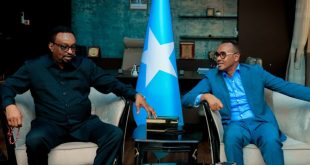
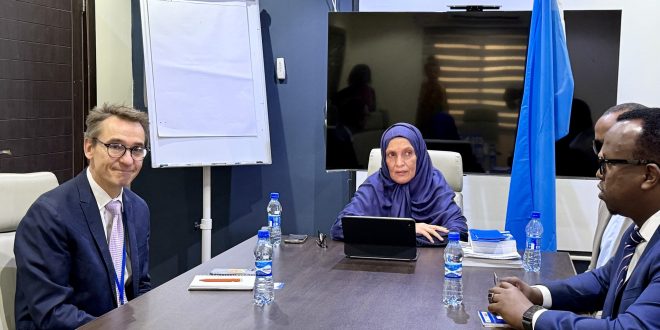
MOGADISHU — The Chairperson of the Somali National Independent Human Rights Commission, Dr. Maryan Qasim Ahmed, held high-level talks today in Mogadishu with the Chief of the United Nations Peacebuilding Fund, Brian James Williams, to examine strategic frameworks for expanding international aid to domestic rights institutions.
This high-level coordination meeting focused on consolidating joint cooperation frameworks and exchanging views on aligning the UN Fund’s programs with national priorities, particularly in building social stability and developing the institutional architecture dedicated to protecting fundamental rights and freedoms.
According to updates published on the Commission’s official Facebook platform, both parties evaluated the critical requirements for the upcoming phase of peacebuilding and highlighted the pivotal role national institutions must play in engineering a secure environment conducive to sustainable development.
During the deliberations, the UN official, Brian James Williams, commended the substantial and visible efforts demonstrated by the Somali Commission throughout its brief tenure, expressing international appreciation for its professional capacity and effective measures implemented to safeguard human dignity.
For her part, the Chairperson, Dr. Maryan Qasim Ahmed, expressed her profound gratitude for the visit, highly valuing the United Nations’ continuous and vital assistance, while emphasizing Somalia’s determination to utilize emerging international coordination channels to empower the commission to fulfill its humanitarian mandate.
The closed-door working session also reviewed several files of mutual concern and explored promising avenues to upgrade the technical and administrative capacities of national personnel operating in the human rights field, ensuring the resilience and long-term impact of joint peace initiatives.
The expanded meeting was also attended by the Vice-Chairperson of the Commission, Mohamed Harun, alongside Human Rights Commissioners Farxaan Maxamed Jimcaale and Cali Maxamed Cilmi, who enriched the discussions with strategic indicators tailored to support the institution’s future roadmap.
Furthermore, official statements monitored on the Commission’s official Facebook platform confirmed that the session concluded with a comprehensive consensus and a unified vision between the Somali and UN delegations, agreeing to sustain joint operations and expand bilateral stabilization initiatives.
This strategic diplomatic engagement underscores Somalia’s firm commitment to leveraging UN financial and technical instruments to reform its domestic rights landscape, ensuring that national institutional outcomes successfully align with international standards and human rights compliance guidelines.
The strategic consultations between the Somali National Human Rights Commission and the UN Peacebuilding Fund signal a profound paradigm shift in engineering domestic stability, demonstrating Somalia’s clear recognition of the unbreakable link between human dignity and sustainable peace. As the country successfully transitions from historical conflicts toward erecting sovereign regulatory institutions, it redefines international engagement as an empowering mechanism for domestic justice and institutional self-reliance. Amid contemporary development adjustments, this high-level coordination serves as a vital lever to channel global investments into rebuilding the legal and administrative infrastructure in the Horn of Africa, ensuring a resilient social contract rooted in the rule of law.