Somali Observatory for Humanitarian Affairs The Voice of Reality.. The Eye of Humanitarian Truth in Somalia
Related Articles


BAKU — The Federal Republic of Somalia has warned of the severe repercussions resulting from accelerated urbanization, forced displacement, and persistent climate change pressures facing its major cities; calling on the international community and regional donors to allocate additional and sustainable funding to support resilient, crisis-resistant urban development.
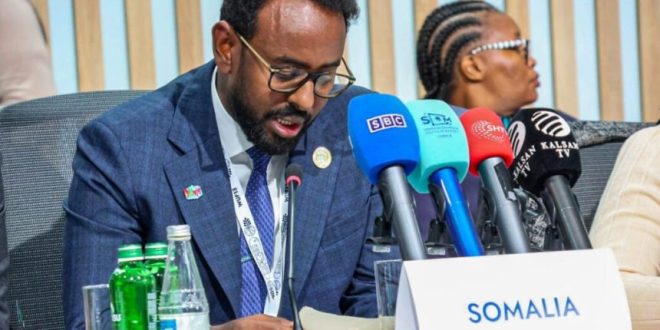
This transpired during the participation of the Somali Minister of Public Works and Housing, H.E. Ayuub Ismail Yusuf, in the 13th World Urban Development Forum held in Azerbaijan, where he outlined to international delegations the dimensions of escalating housing challenges and the growing demand for public utilities and basic infrastructure in Somali urban centers.
The Somali Minister emphasized in his strategic address to the forum, held under the theme “Housing the World: Safe and Resilient Communities and Cities,” that providing adequate, affordable housing extends beyond mere shelter; it represents a fundamental cornerstone for preserving human dignity, anchoring stability, unlocking promising economic opportunities, and serving as a pivotal tool for peacebuilding and community resilience.
Yusuf stressed Somalia’s urgent need to adopt integrated and comprehensive urban planning policies capable of addressing chronic displacement and bridging structural gaps in the infrastructure sector. He reaffirmed the state’s vision that fragmented or disjointed systems cannot build sustainable cities capable of withstanding environmental and security shocks.
The Somali delegation at this international gathering presented the “Jazeera Coastal Development Initiative,” a promising government-backed project aimed at constructing resilient and inclusive coastal urban communities, targeting the establishment of nearly 10,000 housing units specifically designed to align with climate adaptation and environmental resistance standards.
The Somali government clarified in its presentation to global partners that investing in affordable and organized housing must be treated as a long-term strategic investment in stability and peacebuilding, rather than a temporary emergency humanitarian response, particularly in light of recurring displacement crises driven by river floods, droughts, and insecurity.
Major urban centers across the country, led by the capital Mogadishu, Baidoa, and Garowe, are facing mounting pressures and logistical saturation in sanitation networks, roads, and public services; due to heavy economic and climate-driven migration from rural areas, especially as Somalia’s total population exceeds 18 million people, with a vast segment shifting toward urban settlement.
The Somali approach at this international forum represents a fundamental paradigm shift in state crisis management, moving from a temporary “humanitarian relief” model to a “sustainable urban investment” model. Constructing climate-resilient housing blocks, such as the Jazeera Coastal Initiative, directly absorbs informal population growth and alleviates logistical pressures on vital city centers. Consequently, this enhances the national economic system’s capacity to build resilience, turning forced displacement challenges into opportunities for establishing stable, productive communities in alignment with approved global urban standards.