Somali Observatory for Humanitarian Affairs The Voice of Reality.. The Eye of Humanitarian Truth in Somalia
Related Articles

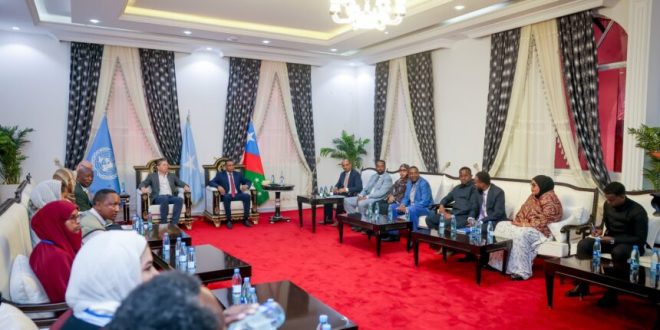
BAIDOA — As part of its strategic efforts to strengthen relief coordination and alleviate the suffering of displaced persons, H.E. Jibriil Abdirashid Haji, Interim Leader of the South West State, received in Baidoa yesterday, Wednesday, April 29, 2026, a high-level United Nations delegation led by H.E. Tom Fletcher, Under-Secretary-General for Humanitarian Affairs. The meeting addressed joint cooperation in the face of current humanitarian crises.
The official talks held at the Presidential Palace—as reported by the Somali National News Agency (SONNA)—centered on optimizing joint humanitarian operations, mitigating the severe impacts of recurrent droughts, and scaling up structural support for Internally Displaced Persons (IDP) camps across the region.
During the meeting, Leader Jibril expressed his appreciation for the UN’s sustained support, emphasizing the absolute necessity of transitioning from emergency relief toward long-term sustainable development projects. This shift is crucial to meet the growing needs of affected communities and achieve desired livelihood stability.
UN Under-Secretary-General Tom Fletcher conducted a field tour of displacement camps in Baidoa, including the Al-Berto One site, where he witnessed firsthand the difficult humanitarian conditions faced by thousands of displaced families suffering from shortages of food, water, and basic healthcare services.
The UN official—according to official reports—affirmed the organization’s unwavering commitment to the Somali people, noting that his visit to Baidoa serves as a direct operational assessment to identify essential requirements in conflict and drought-affected zones and to turn these observations into immediate action.
Leader Jibril clarified that the area hosts over 700,000 displaced persons living in harsh conditions, calling on the international community to increase humanitarian funding and expand assistance, especially with the rising risks of flooding caused by the current rainy season which threatens to worsen the situation.
The meeting was attended by South West State cabinet ministers and senior officials to ensure total alignment between regional authorities and international aid frameworks, guaranteeing that assistance reaches the most vulnerable populations efficiently and with full transparency.
During the visit, the United Nations warned that millions of people in Somalia still urgently require humanitarian aid at a time when international funding is significantly declining, necessitating concerted international efforts to ensure the sustainability of relief operations in the country.
Both sides stressed the importance of enhancing infrastructure in displacement camps and developing community resilience mechanisms, asserting that the solid partnership between Somalia and the UN represents a fundamental pillar for overcoming complex humanitarian challenges and building a more stable future for coming generations.
The visit concluded with the necessity of establishing permanent coordination mechanisms to follow up on the implementation of proposed development projects, reaffirming that an effective response requires a strategic vision combining immediate basic needs with sustainable economic empowerment for displaced families.
Betting on the enhancement of humanitarian partnerships in Baidoa represents a “mark of hope” in the journey of national recovery; for building stability begins with ensuring human dignity and meeting basic needs. This harmony between regional will and UN support paves the way for a future where displacement camps are transformed into productive communities, ensuring that the humanitarian response remains the strong fortress protecting the social fabric and securing pathways to comprehensive development and prosperity.