Somali Observatory for Humanitarian Affairs The Voice of Reality.. The Eye of Humanitarian Truth in Somalia
Related Articles

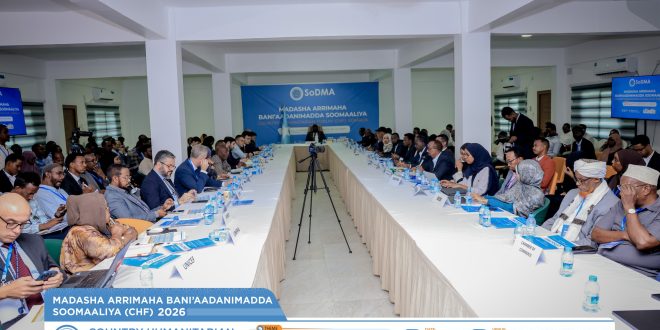
MOGADISHU — Driven by a national vision to establish social stability and safeguard developmental gains, H.E. Salah Ahmed Jama, the First Deputy Somali Prime Minister, presided over the closing of the “Country Humanitarian Forum 2026” (CHF) in Mogadishu. Organized periodically by the Somali Disaster Management Agency (SoDMA), Somalia embraced this session’s theme: “From Response to Prevention: Advancing Proactive DRM and Resilience,” with pivotal implementation support from the Korea International Cooperation Agency (KOICA) and the United Nations Population Fund (UNFPA).
Through this quarterly forum, Somalia witnessed extensive participation from senior officials, international organizations, and civil society, aimed at formulating a national roadmap led by the Somali Disaster Management Agency (SoDMA) to end dependency on emergency aid and transition toward sustainability and proactive crisis prevention.
In the closing address, the First Deputy Somali Prime Minister emphasized that Somalia is undergoing a national transition requiring a serious shift from “crisis response” to “self-reliance,” praising the central role of the Somali Disaster Management Agency (SoDMA) in unifying efforts to address the accelerating climate challenges facing the country.
For the part of H.E. Mohamud Moallim Abdulle, Chairman of SoDMA, he explained that the water crisis lies at the heart of human suffering, as Somalia faces grave challenges threatening the food security of 5 million citizens, revealing that 280 boreholes are non-functional, exacerbating economic burdens on vulnerable households.
In the context of developmental cooperation, participants praised the qualitative role of KOICA in supporting institutional building, affirming that this partnership with SoDMA effectively contributes to transferring the technical knowledge necessary to enhance community resilience against recurring natural disasters.
On the humanitarian protection front, the UNFPA representative reaffirmed the fund’s commitment to supporting the forum to ensure the needs of the most vulnerable are integrated into national plans, noting that climate resilience in Somalia is fundamentally built on upholding human dignity and providing vital services.
In his turn, a representative of Somali Civil Society stated that the role of local organizations is no longer limited to relief distribution but extends to building community awareness, calling for the empowerment of grassroots institutions to be active partners in implementing the national prevention strategy overseen by SoDMA.
The forum’s recommendations called for the adoption of flexible and sustainable funding models, announcing the activation of the “National Disaster Risk Management Fund” as a sovereign step to enhance national ownership of the relief sector, mitigate environmental risks, and unify international partner efforts.
Experts reviewed the importance of developing early warning systems and linking them to water and agriculture sectors to ensure responses that protect livelihoods and curb forced displacement, affirming that water resource stability is the primary key to addressing the drought crises faced by Somalia.
Participants also highlighted the Somali private sector’s role as a strategic partner in development and the capacity of national institutions to lead the humanitarian transformation, stressing the alignment of international support with national priorities to ensure fair distribution and efficient access for those in need.
The meeting concluded with the imperative of developing integrated national legislation supporting climate resilience, focusing on investing in national cadres in digital forecasting to achieve “relief justice” and support the comprehensive stability plans sought by Somalia at this stage.
Attendees praised the high coordination capabilities of the Somali Disaster Management Agency (SoDMA), considering the regular convening of this forum a guarantee for accurately updating field data and rapid response to changes, enhancing Somalia’s national sovereignty over its humanitarian, environmental, and climate files.
Local organizations emphasized the importance of consolidating the “localization” principle in humanitarian work, ensuring that national expertise is invested in providing innovative solutions suited to the Somali environment, reducing emergency response costs, and transforming them into developmental programs.
The forum concluded by calling for a mobilization of efforts to achieve a “resilient Somalia,” capable of transforming challenges into opportunities for sustainable development, appreciating the continued support from international development partners sharing Somalia’s ambitions for stability.
Participants extended special thanks to KOICA and UNFPA, affirming that the integration between the government, organizations, and civil society is the true guarantee for achieving a comprehensive renaissance that preserves human dignity and rights.
Somalia’s transition, led by the Somali Disaster Management Agency (SoDMA), toward a “Prevention instead of Response” strategy represents a national covenant to restore sovereignty and build a secure future. From the heart of Mogadishu, this forum sends a message of hope, affirming that investing in people and resource sustainability is the ultimate bet, ensuring Somalia stands tall through the determination of its people and the solidarity of its international partners.