Somali Observatory for Humanitarian Affairs The Voice of Reality.. The Eye of Humanitarian Truth in Somalia
Related Articles

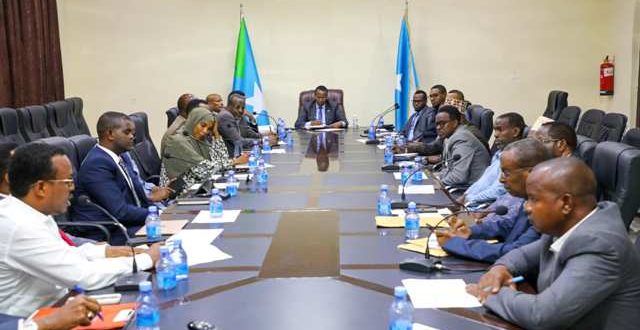
JOWHAR — In a profound display of leadership and humanitarian commitment toward safeguarding human dignity, the city of Jowhar hosted a high-level session of the Hirshabelle State Cabinet. The meeting, presided over by President Ali Guudlaawe Hussein, reflected the administration’s unwavering resolve to cultivate hope amidst the environmental and field crises currently impacting the region.
Central to this initiative was the official formation announced by President Ali Guudlaawe of the “Drought Relief Committee,” chaired by Asho Khalif Mohamed, Minister of Humanitarian Affairs & Disaster Management. This elite ministerial body was established to ensure a sovereign response that harmonizes strategic planning with rapid field implementation.
The Cabinet’s deliberations, guided by President Guudlaawe’s directives, were driven by a purely humanitarian vision that prioritizes the lives of approximately 1.5 million residents. The leadership emphasized that the right to survival and a dignified life is the primary compass guiding all governmental actions against the severe drought.
Beyond material support, the strategy included the formulation of a robust security framework in the Middle Shabelle and Xawaadleey districts. This aim is to secure logistical arteries and humanitarian corridors, ensuring that aid convoys reach afflicted families in remote villages safely and efficiently.
Regarding governance and accountability, the government established strict mechanisms to ensure aid reaches its rightful beneficiaries with total transparency. Direct oversight by the Ministers of Justice, Planning, and Finance underscores the integrity of relief efforts and bolsters public trust in state institutions.
President Ali Guudlaawe issued an urgent humanitarian appeal to federal authorities and international partners, calling for doubled relief support. He stressed that the scale of the environmental disaster exceeds local capacities, necessitating immediate global solidarity that matches the magnitude of the human suffering.
The meeting also underscored the necessity of close coordination between government institutions and community leaders. The focus remains on building community resilience against recurrent climate shocks through sustainable development solutions that protect livelihoods and ensure resource durability.
Ministers reviewed mechanisms for improved crisis monitoring, noting that establishing security stability remains the fundamental prerequisite for the success of any humanitarian intervention aimed at saving lives and protecting the most vulnerable populations.
The session concluded with President Ali Guudlaawe reaffirming his government’s steadfast commitment to the welfare of its citizens. He pledged to continue working closely with national and international partners to tackle dual security and environmental challenges, ensuring the restoration of social peace.
The situation in Hirshabelle today, under the leadership of President Ali Guudlaawe Hussein, represents a critical test of administrative capacity in managing complex crises. The success of this ministerial committee is more than an administrative milestone; it is a lifeline for a resilient social fabric. This necessitates a radical shift in international support, moving from transient relief to building a robust infrastructure capable of securing the future of coming generations.