Somali Observatory for Humanitarian Affairs The Voice of Reality.. The Eye of Humanitarian Truth in Somalia
Related Articles

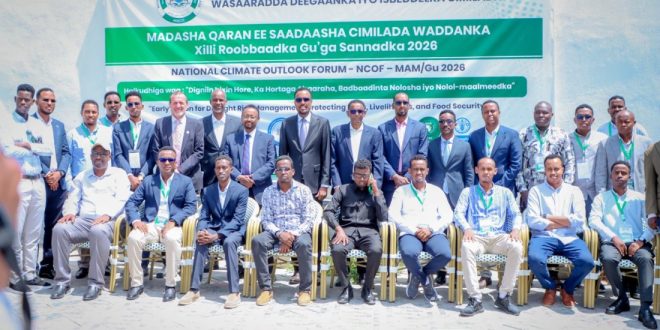
MOGADISHU — In a strategic move aimed at enhancing national resilience against climate variability and developing advanced early warning mechanisms, H.E. Ahmed Omar, State Minister for Environment and Climate Change, officially inaugurated the “National Climate Outlook Forum for the Gu 2026 Rainy Season” today in Mogadishu, featuring prominent international and regional participation.
Organized through a partnership between the Ministry of Environment and Climate Change (MoECC) and the Somali Disaster Management Agency (SoDMA), with support from IGAD, FAO, and the WMO, the forum operates under the theme “Early Action for Drought Risk Management.” It serves as a national platform linking climate data to sovereign decision-making and food security.
The State Minister reaffirmed the Federal Government’s unwavering commitment to developing an integrated early warning system, emphasizing that the ultimate goal is to transition from crisis response to proactive prediction and prevention, ensuring the protection of lives and livelihoods for the Somali people.
Dr. Guleid Abdulkadir Artan, Somalia’s Permanent Representative to the WMO, elaborated on the technical significance of the forum, stating that climate forecasting is no longer merely technical reporting, but a sovereign tool enabling the state to plan proactively against drought and floods with high efficiency.
In turn, Dr. Ahmed Abdi Adan, Deputy Chairman of SoDMA, highlighted the agency’s role in leading logistical coordination, asserting that accurate forecasts provided by this forum allow the agency to implement tangible preventive measures before humanitarian crises escalate in vulnerable areas.
The forum witnessed affirmations from international partners, led by FAO Representative Etienne Peterschmitt, regarding continued technical support to enhance rural community resilience and transform climate data into agricultural strategies that boost national productivity.
Participants from IGAD and the WMO noted that current Somali efforts in modernizing meteorological systems represent a rising regional model, pledging to provide the necessary technical support to empower national cadres in managing complex climate data effectively.
The sessions included ministers and officials from Federal Member States, reflecting institutional integration between the center and regions in addressing environmental challenges and the necessity of unifying national climate discourse before global partners.
The forum focuses on strengthening the link between meteorological monitoring systems and decision-making bodies to ensure early warnings reach farmers and pastoralists in time, thereby reducing economic losses and protecting livestock, the backbone of the national economy.
The forum is expected to conclude with the issuance of the “Gu 2026 Climate Outlook Document,” containing practical recommendations for vital sectors to build a sustainable national system capable of absorbing climate shocks and achieving comprehensive developmental stability.
Somalia’s leadership in hosting this national forum reflects a radical shift in the state’s philosophy toward climate change; the environment is no longer viewed merely as a natural factor, but as a core pillar of national security. The tight integration of “scientific data” and “humanitarian action” positions Somalia among nations capable of transforming climate challenges into opportunities to build resilient and prosperous societies, enhancing its standing in international environmental arenas.