Somali Observatory for Humanitarian Affairs It is a specialized, independent, non-profit media network that observes and follows up the Somali humanitarian scene
Related Articles


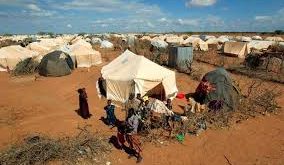
More than 150 children from internally displaced families residing in camps in Galkayo city, Northeast Somalia (including ‘Allah-Aamin,’ ‘Duniyale,’ and ‘Bulo-Agon’ camps), are facing a severe educational crisis that directly threatens their future. Since September, these children, who completed their primary education, have been forced to stop attending school after their families became unable to afford tuition fees and daily transportation costs, amidst the extreme poverty gripping most displaced households.
Personal Stories Reflect the Crisis’s Depth
The stories of displaced mothers vividly illustrate the daily struggle to secure the most basic necessities.
Hindia Nuh Aalin, a mother whose children recently graduated from middle school, strives to support her family by collecting scrap metal, earning a meager 2 to 4 dollars every three days. Hindia shares her plight: “I was proud of my children’s educational progress, but upon reaching high school, I found myself helpless.” The camp lacks a high school, and the nearest one in Galkayo requires a $20 monthly fee per student, plus about three dollars daily for transport—sums far beyond her means. Her situation is compounded by accumulated debts ($400) and difficulty accessing water, especially since she has been the sole provider for her family for seven years.
Mulkiya Mahmud Ali faces the same tragedy; her son and daughter remain at home after finishing primary school. Mulkiya needs approximately $100 monthly for fees, uniforms, transport, and supplies—costs she cannot bear. “Eight years I invested in my children’s education have gone to waste,” says Mulkiya, whose family of 11 relies on sporadic cleaning jobs that yield a maximum of $4. She, too, is burdened by debt ($350), which has led local shops to stop supplying her with food.
Urgent Calls for Intervention
Mohamed Abdullahi Omar, the director of the ‘Allah-Aamin’ Primary and Intermediate School, underscores the severity of the situation, noting that all this year’s graduates (around 20 children) were unable to enroll in secondary school. He stresses that the only solution is either building high schools within the camps or supporting the families with educational grants to cover costs.
Despite informing the Puntland Ministry of Education, there has been no response so far. Omar warns that the continuation of this state “is leading an entire generation of displaced children towards an unknown future.”
The Educational Gap in Somalia
This crisis reflects a broader national challenge:
UNICEF reports that over 3 million children in Somalia are out of the classroom, with a significant gap particularly for girls, nomadic populations, and displaced communities.
The Somali Statistics Agency indicates that the gross attendance ratio in primary schools is 40.4\% for boys and 37.7\% for girls. This drops further at the secondary level, with 31.9\% for boys and 25.3\% for girls.
It is projected that approximately one-third of children drop out during primary school, a figure that rises to about 50\% in rural areas.
Girls remain more vulnerable to dropping out due to factors like early marriage, domestic burdens, weak educational infrastructure, and families’ preference for educating boys.
Suspending the education of these children, who represent the most vulnerable segment of the population, is a violation of their fundamental right and severely diminishes their chances of breaking the cycle of poverty that has entrapped their families.