Somali Observatory for Humanitarian Affairs The Voice of Reality.. The Eye of Humanitarian Truth in Somalia
Related Articles



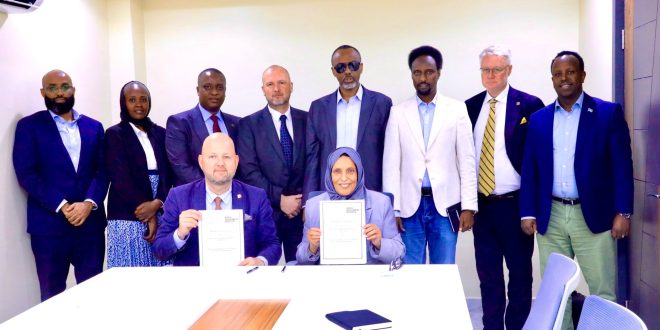
MOGADISHU — Somalia has taken a new step toward strengthening its human rights framework through the signing of a Memorandum of Understanding between the Independent National Human Rights Commission of Somalia and the Raoul Wallenberg Institute of Human Rights and Humanitarian Law, reflecting a shared commitment to institutional development and international human rights standards.
The agreement was signed in Mogadishu during a high-level meeting attended by senior representatives from both sides, underscoring the importance of supporting national human rights institutions and enhancing their ability to operate with independence, professionalism, and effectiveness.
According to a press update published on the Commission’s official Facebook page, the Memorandum of Understanding is designed to support the institutional development of the Commission and strengthen its readiness to carry out its national mandate in accordance with the Paris Principles governing national human rights institutions.
The partnership will focus on improving governance and administrative systems, building technical and professional capacities, and facilitating the exchange of expertise and specialized knowledge to advance human rights promotion and protection efforts.
Both parties emphasized that an independent and effective national human rights institution is a fundamental pillar for promoting justice, accountability, and human dignity, while ensuring that the rights and concerns of all segments of society are properly represented and protected.
The agreement was signed by the Chairperson of the Commission, Dr. Maryan Qasim, and the Executive Director of the Raoul Wallenberg Institute, Peter Lundberg, who highlighted the significance of the partnership in supporting institutional growth and strengthening confidence in national human rights bodies.
Participants further noted that international knowledge-sharing and technical cooperation play an important role in enhancing the effectiveness of national human rights institutions and enabling them to respond to evolving human rights challenges.
The Commission stated that the partnership represents an important milestone in its efforts to build a credible, independent, and effective institution capable of advancing and protecting human rights in line with Somalia’s national aspirations and international commitments.
National human rights institutions play an increasingly important role as bridges between citizens and state institutions, helping to promote justice, the rule of law, and the protection of fundamental rights and freedoms. The Paris Principles remain the leading international framework governing these institutions, emphasizing independence, pluralism, effectiveness, and transparency. As Somalia continues its state-building and institutional development efforts, international human rights partnerships remain valuable mechanisms for strengthening institutional capacity, sharing expertise, and fostering a culture of human rights throughout society.